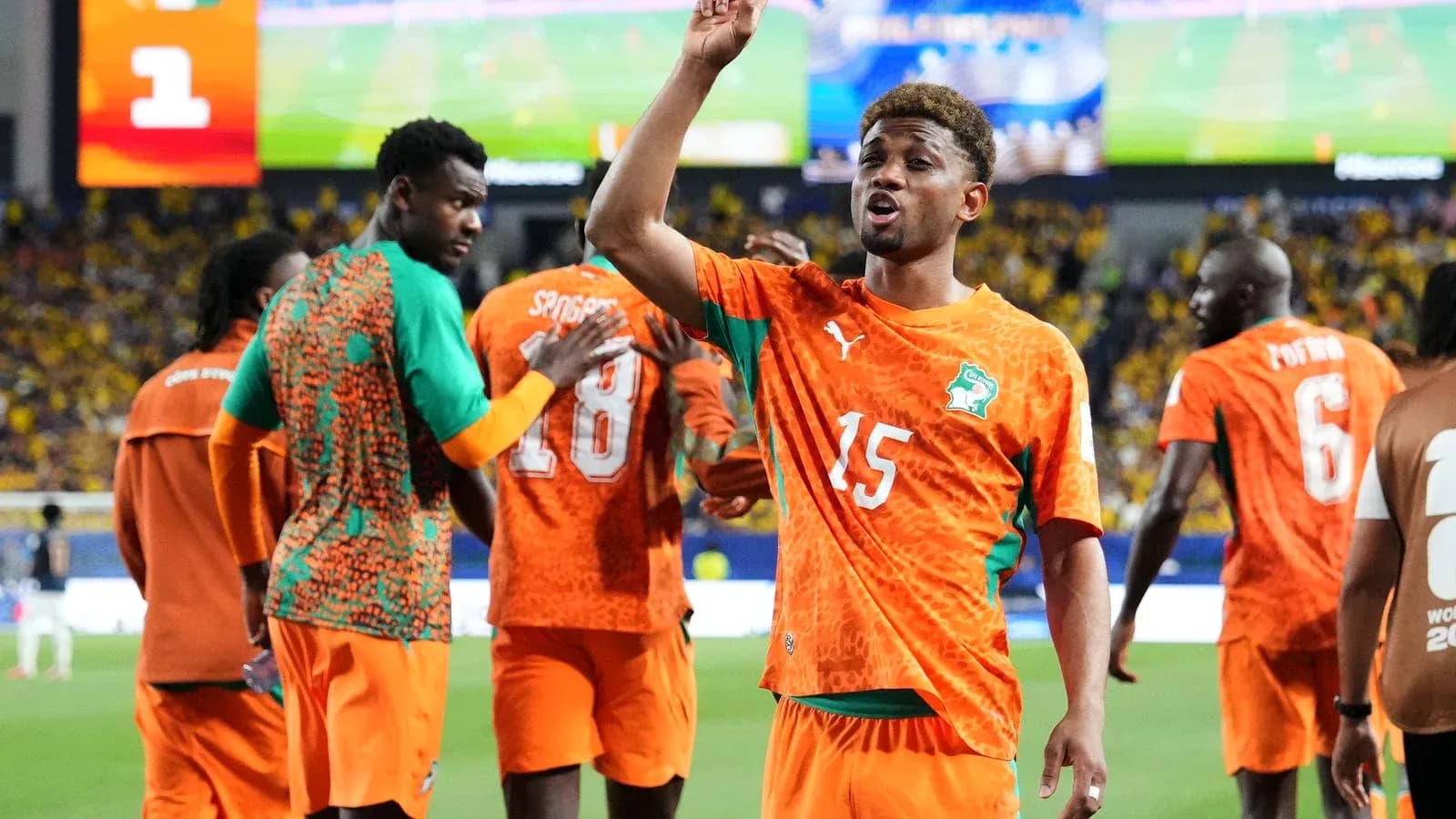
Ivory Coast's Tactical Mastery in 1-0 Victory Over Ecuador
Ivory Coast’s 1-0 win over Ecuador at Lincoln Financial Field was a classic example of a side bending without breaking, then striking with a late, well-prepared pattern. Both teams lined up in a 4-4-2, but the way they used that shape diverged sharply over 90 minutes, with Ivory Coast prioritising verticality and Ecuador leaning into controlled possession.
Ecuador finished with a slight edge in the ball (52% to 48%) and a marginally better passing rate — 492 passes, 419 accurate (85%) against Ivory Coast’s 470 passes, 397 accurate (84%). But the shot profile and xG tell a different story. Ivory Coast generated 15 total shots to Ecuador’s 12 and led 4–1 in shots on goal. Their xG of 1.52 versus Ecuador’s 1.01 underlines that Emerse Fae’s side created the clearer chances despite having less of the ball.
Ivory Coast's Structure
Structurally, Ivory Coast’s 4-4-2 was built on a strong central axis. Franck Kessié and Seko Fofana formed an aggressive double pivot, stepping high to disrupt Moisés Caicedo and Pedro Vite. With eight shots inside the box and only seven from range, Ivory Coast consistently managed to progress into dangerous central and half-space zones rather than being forced into speculative efforts. The wide midfielders, Yan Diomande and Bazoumana Touré, tucked in to form a compact midfield four out of possession, leaving full-backs Guéla Doué and Ghislain Konan to provide width on the overlap when the ball was secured.
Ecuador's Approach
Ecuador’s 4-4-2 under Sebastian Beccacece was more patient. The back four of Alan Franco, Joel Ordóñez, Willian Pacho and Piero Hincapié circulated possession to draw Ivory Coast’s first line out, with Caicedo dropping to form a situational three in build-up. That structure helped them to the possession edge and similar total shots (12), but the quality of those looks was lower: five shots inside the box and seven outside, and only one effort actually tested Yahia Fofana (Ivory Coast).
Tactical Changes
The decisive tactical swing came through substitutions and how they reconfigured Ivory Coast’s front line. Initially, Nicolas Pépé and Elye Wahi started as the two forwards, offering depth runs and channel movement. On 56', Fae made a double attacking change that altered the dynamic: Ange-Yoan Bonny (IN) came on for Elye Wahi (OUT), and Amad Diallo (IN) came on for Bazoumana Touré (OUT). This effectively shifted Ivory Coast towards a more fluid front pairing, with Bonny as a reference and Diallo drifting between the lines from the right half-space.
Those changes were followed by further adjustments that kept the structure stable but refreshed the energy. At 77', Christ Inao Oulaï (IN) came on for Nicolas Pépé (OUT), and Ibrahim Sangaré (IN) replaced Seko Fofana (OUT), adding fresh legs and defensive security in midfield while maintaining a threat in transition. At 89', Odilon Kossounou (IN) replaced Guéla Doué (OUT), shoring up the right side ahead of the closing minutes.
Winning Goal
The winning goal at 90' was the product of this retooled attacking unit and a rehearsed pattern. Amad Diallo, who had been introduced as part of the 56' reshuffle, finished the move, assisted by Wilfried Singo. The centre-back stepping into an advanced area late on reflects Ivory Coast’s willingness to commit a defender forward when Ecuador’s structure was stretched by the fresh forwards. With Ecuador’s defensive line disrupted by earlier changes — notably Jackson Porozo (IN) for Alan Franco (OUT) at 62' and Kevin Rodriguez (IN) for Enner Valencia (OUT) at 77' — the marking and depth control on the right side were less cohesive, allowing Singo to progress and find Diallo.
Defensive Strategies
Defensively, Ivory Coast combined controlled aggression with a calculated foul profile: 10 fouls and three yellow cards. The bookings underline how they managed transitions and duels. At 28', Seko Fofana (Ivory Coast) — Roughing; at 38', Franck Kessié (Ivory Coast) — Tripping; at 40', Guéla Doué (Ivory Coast) — Tripping. All three cards came in the first half, signalling a clear intent to prevent Ecuador from building rhythm through the middle and wide-right channels where Gonzalo Plata and John Yeboah were trying to combine.
Ecuador, by contrast, committed 13 fouls but only received one yellow card: at 73', Jackson Porozo (Ecuador) — Holding. That incident reflected Ecuador’s increasing need to break up Ivory Coast’s more direct attacks once the substitutes had injected pace and unpredictability.
Goalkeeping Performance
In goal, Yahia Fofana (Ivory Coast) had a relatively quiet but precise evening, officially making 1 save. The low shot-on-target figure (1) for Ecuador shows how effectively Ivory Coast’s back four and midfield shield limited clean looks, even as Ecuador circulated the ball and reached 12 total shots. At the other end, Hernán Galíndez (Ecuador) made 3 saves, with his 0.22 goals prevented figure matching Fofana’s. That parity in goals prevented, combined with Ivory Coast’s higher xG, underlines that Galíndez was the busier and more exposed goalkeeper despite Ecuador’s possession edge.
Statistical Overview
Statistically, the match tilts narrowly but clearly towards Ivory Coast in terms of threat and control in key zones. Both sides blocked three shots, indicating committed defending in their own penalty areas. Ecuador’s five corners to Ivory Coast’s three show that Beccacece’s team did generate territorial pressure, but the inability to convert that into high-quality chances — reflected in the 1.01 xG and just one shot on goal — points to Ivory Coast’s strong defensive organisation and compact 4-4-2 block.
The 1-0 scoreline, with Ivory Coast scoring in regular time at 90', is entirely consistent with the underlying data: a balanced game in possession and passing accuracy, but with Ivory Coast crafting the better opportunities, defending their box more cleanly, and using substitutions more effectively to tilt the tactical battle in the final quarter-hour.