Ivory Coast's Statement Victory Over Ecuador in World Cup Opener
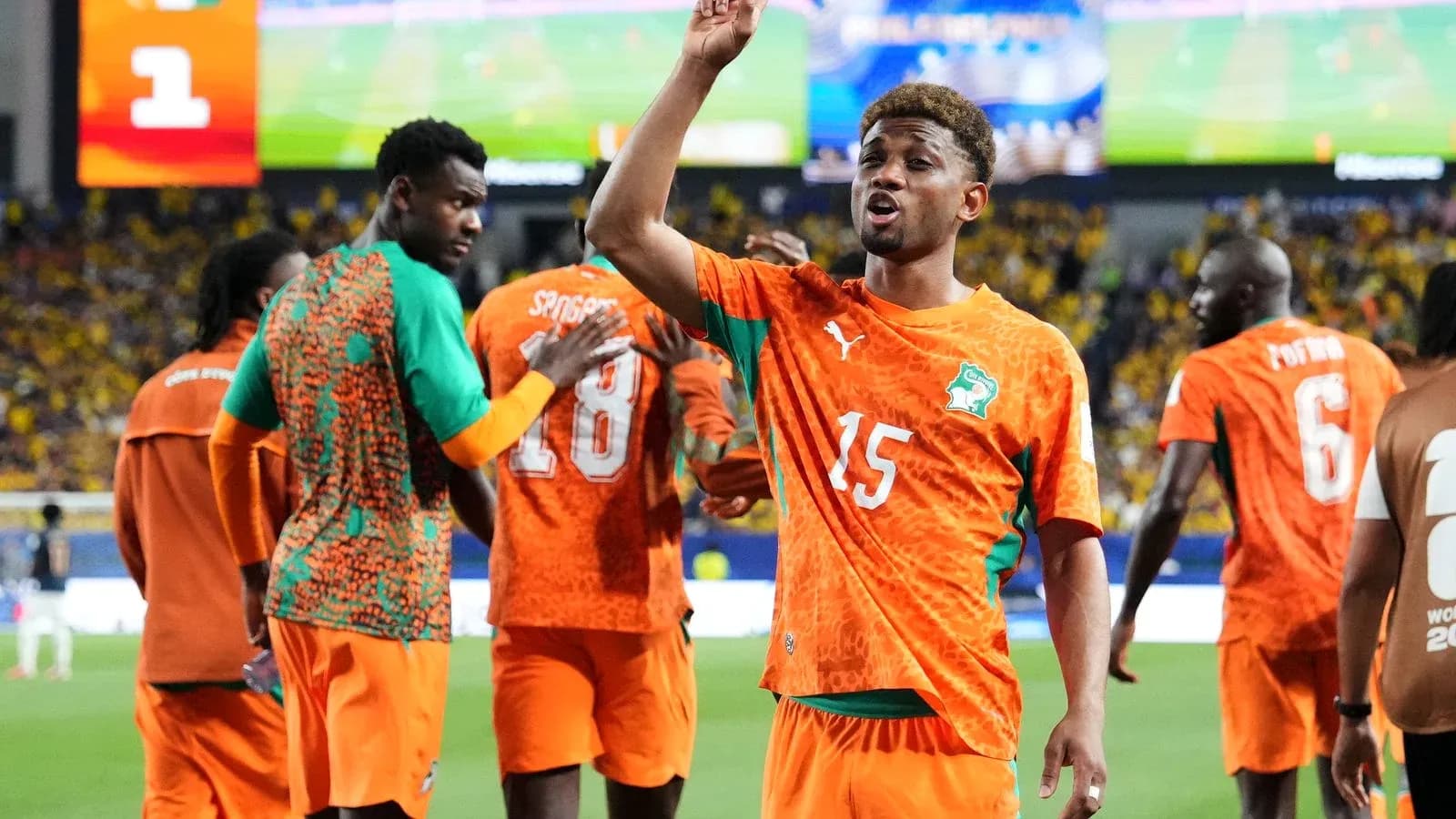
Under the Philadelphia lights at Lincoln Financial Field, Ivory Coast’s 1–0 victory over Ecuador felt less like a routine group opener and more like a statement of intent. Following this result, the World Cup Group E table shows Ivory Coast in 2nd with 3 points, a goal difference of +1 (1 scored, 0 conceded), while Ecuador sit 3rd with 0 points and a goal difference of -1 (0 scored, 1 conceded). After just one match each, identities are already emerging: Ivory Coast as a compact, physically imposing 4-4-2, Ecuador as a side still searching for fluency in the same shape.
I. The Big Picture – Two 4-4-2s, one clearer idea
Both teams lined up in a 4-4-2, but the symmetry on paper masked very different interpretations.
Emerse Fae’s Ivory Coast used their 4-4-2 as a platform for control. At home in this tournament context (their only match so far has been this “home” fixture), they have played 1, won 1, with 1.0 home goals for on average and 0.0 against. The back four of G. Konan, E. Agbadou, W. Singo and G. Doue sat behind a powerful midfield band of four: B. Toure wide left, Y. Diomande wide right, with S. Fofana and F. Kessie patrolling the center. Up front, N. Pepe and E. Wahi offered a blend of depth-running and one‑v‑one threat.
Sebastian Beccacece matched the shape but not the cohesion. Ecuador’s season line so far is stark: on their travels they have played 1, lost 1, with 0.0 away goals for and 1.0 away goals against. The back four of P. Hincapie, W. Pacho, J. Ordonez and A. Franco had to absorb long spells without the ball, protected by a midfield of A. Minda, P. Vite, M. Caicedo and J. Yeboah. Ahead of them, G. Plata and E. Valencia were often isolated, forced to chase direct balls rather than combine in settled possession.
II. Tactical Voids – Discipline lines and missing edges
Injury absences are not flagged in the data, so the more telling voids are structural and disciplinary.
Ivory Coast’s card profile this campaign is revealing. Heading into this game they had not played; now, across their single match, all 3 yellow cards have arrived before half-time: 1 between 16–30 minutes (33.33%) and 2 between 31–45 minutes (66.67%). That early spikiness, embodied by S. Fofana’s booking, hints at a side that sets the physical tone early, risking cautions to impose themselves in midfield. Crucially, they have no red cards and closed the game out cleanly.
Ecuador’s discipline is more back‑loaded. Their only yellow so far has landed in the 61–75 minute window, a late-game spike where 100.00% of their cards have come. That fits the narrative of a chasing team: as legs tire and the scoreboard pressures rise, fouls become more desperate. J. Porozo, who appears in both the top yellow and top red card lists for the competition data set, embodies that edge; in his 28 minutes he committed 2 fouls and was booked once. Even without a red here, his profile is a warning about how Ecuador’s defensive aggression can tip over under stress.
The other void is attacking sharpness. Ecuador have failed to score in their only outing so far (failedToScore: away 1, total 1). Their 4-4-2 has yet to produce a single goal, and without penalty opportunities (0 taken, 0 scored, 0 missed) they have had no set-piece lifeline either.
III. Key Matchups – Hunter vs Shield, Engine Room vs Enforcer
Hunter vs Shield
Ivory Coast’s attacking “hunter” in this squad is increasingly A. Diallo. Off the bench, he has already scored 1 goal from 2 shots on target in 34 minutes, with an 8.2 rating. His dribbling numbers are elite for such a short cameo: 6 attempts, 5 successful, plus 1 key pass. He is not in the starting XI here, but his presence among the substitutes transforms the second-half threat profile: when the game stretches, he can be introduced to attack tired full-backs in wide or half-space channels.
Opposite him is Ecuador’s “shield”: a back line that, overall this campaign, has conceded 1 goal in total, all on their travels, for an average of 1.0 away goals against. W. Pacho and P. Hincapie are the anchors of that unit, supported by a compact midfield screen led by M. Caicedo. The structure is not collapsing—1 goal conceded in 1 match is not catastrophic—but it is brittle once Ecuador are forced to open up and chase.
Engine Room – Kessie and S. Fofana vs Caicedo and Vite
The real contest, though, is in the engine room. F. Kessie and S. Fofana form a double pivot with complementary traits. Fofana’s statistical line from this matchday block is telling: 36 passes at 88% accuracy, 1 key pass, 1 blocked shot, 2 interceptions, and 4 shots taken. He is both controller and vertical threat, stepping into the half-spaces to shoot while still recovering to screen counters.
On the other side, M. Caicedo is Ecuador’s enforcer and distributor. Flanked by the more creative P. Vite and the dynamic width of J. Yeboah and A. Minda, he is asked to do a huge amount of defensive work while also sparking transitions. The problem, as the early numbers show, is that Ecuador’s midfield cannot yet convert that work into chances: 0 total goals for, no penalty situations forced, and no assist leaders emerging in the competition data.
IV. Statistical Prognosis – Ivory Coast’s control vs Ecuador’s need to gamble
Following this result, the statistical balance is clear. Ivory Coast’s overall record in the tournament stands at 1 win from 1, with 1.0 total goals for on average and 0.0 total goals against. They have already posted 1 clean sheet in total and have not failed to score. Their biggest home win is 1–0, and that is precisely the template: controlled, low‑event football where their structure and physicality suffocate opponents.
Ecuador, by contrast, are in a fragile spot. Overall they have played 1, lost 1, with 0.0 total goals for and 1.0 total goals against. They have 0 clean sheets and have failed to score in their only match. Their biggest away loss is 1–0, underscoring a side that can stay in games but lacks the cutting edge to change them.
Without xG values in the dataset, we infer from patterns: Ivory Coast’s shot volume from midfield (Fofana’s 4 efforts) and the impact of a high‑efficiency dribbler like A. Diallo suggest they are generating higher-quality chances than Ecuador’s static front two. Defensively, Ivory Coast’s 0.0 average goals against in total speaks to a unit that limits clear looks at goal.
Tactically, that points toward a future in which Ivory Coast continue to lean on their 4-4-2 as a control mechanism, introducing Diallo and S. Adingra from the bench to tilt late-game scenarios. Ecuador will need to loosen their own 4-4-2, perhaps by unleashing more of K. Paez’s creativity or using J. Caicedo’s running in behind, if they are to overturn a statistical narrative that currently casts them as disciplined but blunt.
For now, the numbers and the eye test align: Ivory Coast are built to manage margins; Ecuador must learn to disrupt them.