Mexico Dominates South Africa 2-0 in World Cup Opener
Mexico’s 2-0 win over South Africa at Estadio Azteca was a textbook case of territorial control, structured possession and intelligent use of an extra man, rather than a sheer attacking onslaught. Javier Aguirre’s side, in a 4-1-4-1, turned 61% possession and a 16–3 shot advantage into a controlled group-stage opener, while Hugo Broos’ 5-3-2 never really escaped its own half, especially after being reduced to nine men.
Mexico’s shape was clear from the first whistle. Erik Lira anchored as the single pivot ahead of the back four, allowing both interiors, Brian Gutiérrez and Álvaro Fidalgo, to operate between the lines. Wide, Roberto Alvarado and Julián Quiñones started nominally as advanced midfielders but repeatedly pushed into the half-spaces, leaving the flanks to the full-backs. This structure created a 3-2 base in possession: Lira often dropped between César Montes and Johan Vásquez, with Jesú́s Gallardo stepping high on the left and Israel Reyes providing a more conservative outlet on the right.
The first goal on 9 minutes encapsulated this plan. Mexico circulated patiently, using their passing superiority — 520 passes to South Africa’s 335, at 90% versus 81% accuracy — to pull the back five narrow. Lira then stepped forward from the pivot line to find Quiñones between the lines, and the midfielder finished, rewarding the vertical connection from deep. That sequence reflected the broader pattern: Mexico’s midfield triangle consistently outnumbered South Africa’s central trio, with Lira dictating tempo and Fidalgo drifting into pockets to overload the right half-space.
South Africa’s 5-3-2 was built to absorb pressure and counter through Lyle Foster and Iqraam Rayners, but their attacking threat was minimal: only 3 total shots, 1 inside the box, and xG of 0.07. The back five stayed very flat, with wing-backs Khuliso Mudau and Aubrey Modiba pinned deep by Mexico’s wide players and overlapping full-backs. Teboho Mokoena tried to step out to press Lira, but this simply opened lanes for Gutiérrez and Fidalgo. The early yellow card for Mokoena on 17 minutes further constrained his aggression, reducing South Africa’s ability to disrupt Mexico’s build-up.
The match’s key tactical hinge came at 49 minutes. Siphephelo Sithole’s “Professional foul last man” red card removed one of South Africa’s central midfielders and forced a structural compromise. Down to ten, Broos’ side effectively shifted into a 5-2-2/5-2-1-1, with Jayden Adams and Mokoena trying to cover impossible horizontal distances. Mexico immediately exploited this, circulating the ball side-to-side and forcing constant lateral shuffles from a now-understaffed midfield. The numerical superiority in the middle third became overwhelming.
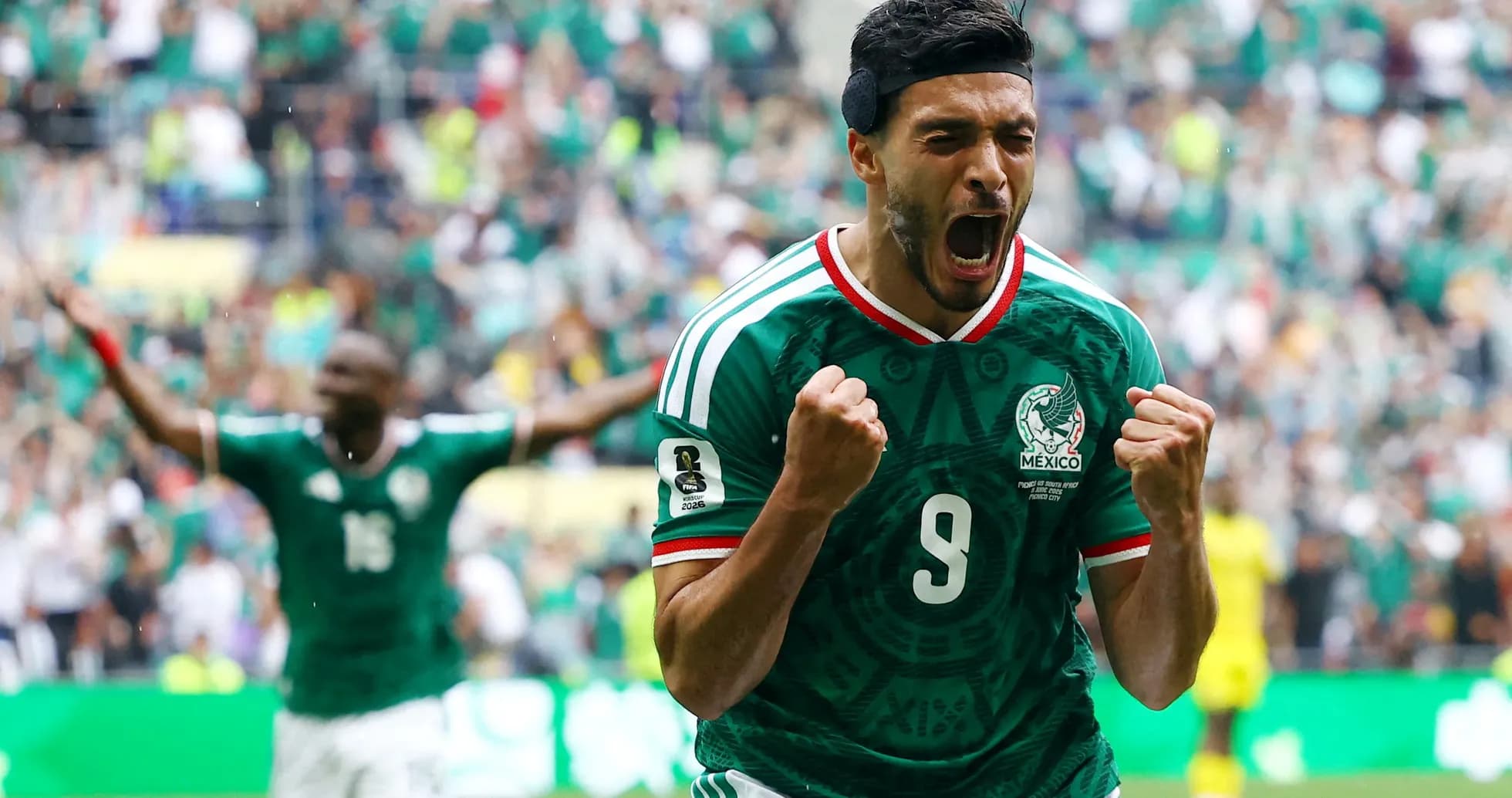
Aguirre’s in-game management reinforced this dominance. On 66 minutes, Gilberto Mora (IN) came on for Fidalgo (OUT), and Luis Chávez (IN) replaced Gutiérrez (OUT), injecting fresh legs and maintaining Mexico’s technical control in central areas. Within a minute, the second goal arrived: Raúl Jiménez, the lone striker, finished a move assisted by Alvarado, who had been drifting inside all game to combine with the midfielders. The goal at 67 minutes reflected Mexico’s improved verticality after the changes: more direct runs from the second line and quicker combinations around the box.
The substitution pattern also showed Aguirre’s intent to manage energy and protect the lead rather than chase an inflated scoreline. At 76 minutes, Armando González (IN) replaced Jiménez (OUT), and Edson Álvarez (IN) came on for Lira (OUT), effectively refreshing both the spearhead and the holding role while preserving the 4-1-4-1 structure. Later, Alexis Vega (IN) replaced Quiñones (OUT) at 79 minutes, adding a new left-sided threat to stretch a tiring South African back line.
South Africa’s changes were more reactive than proactive. At 56 minutes, Thalente Mbatha (IN) came on for Foster (OUT), and at 61 minutes Themba Zwane (IN) replaced Adams (OUT), attempts to stabilize midfield and offer ball retention. But the red card had already forced them into deep survival mode. Later, Oswin Appollis (IN) for Modiba (OUT) and Evidence Makgopa (IN) for Rayners (OUT) at 77 minutes slightly refreshed the front and left side, yet the basic problem remained: they could not progress the ball cleanly against Mexico’s rest defense.
Defensively, Mexico’s back four were rarely stretched. With South Africa producing only 2 shots on goal and 3 total attempts, Raúl Rangel (Mexico) was largely protected by an effective counter-press led by Lira and later Álvarez. The team’s 5 blocked shots underline how often Mexico defended high, stopping transitions before they reached the box. South Africa, by contrast, did not register a single blocked shot, a sign of how rarely they were able to step out to challenge Mexico’s efforts around the area.
Discipline significantly shaped the late phases. South Africa finished with two red cards: Sithole’s “Professional foul last man” on 49 minutes and Zwane’s “Violent conduct” on 84 minutes, the latter coming after a VAR “Card upgrade” review at 82 minutes. Mexico’s own defensive line was finally breached numerically when Montes saw red for “Professional foul last man” at 90+2 minutes, leaving both sides reduced but without time for the game state to change. Across the match, Mexico committed 12 fouls to South Africa’s 11, but it was South Africa’s more desperate, last-man interventions that proved decisive.
Statistically, Mexico’s 2-0 scoreline aligned closely with their xG of 1.41, while South Africa’s 0.07 underlined how comprehensively they were shut down. Both goalkeepers, Raúl Rangel (Mexico) and Ronwen Williams (South Africa), recorded 2 saves each, but the contexts were different: Williams was exposed by a stretched block facing 16 shots, whereas Rangel operated behind a dominant structure that limited South Africa to speculative efforts. Mexico’s 520 passes, 467 accurate (90%), compared with South Africa’s 335, 272 accurate (81%), framed a match in which the ball, territory, and tactical initiative all belonged to the hosts, who converted that control into a secure opening World Cup group-stage victory.