Portugal's Tactical Masterclass Against Croatia in World Cup Knockout
Portugal’s 2-1 victory over Croatia at BMO Field in the World Cup Round of 32 was defined by territorial control, structural tweaks around the hour mark, and a late, high‑risk reshaping of the attacking line. Despite trailing to Ivan Perišić’s opener, Portugal’s superior possession (61% to 39%), passing volume (584 to 368) and xG (2.18 to 1.34) underpinned a comeback that was as much about systemic adjustment as individual quality.
Roberto Martinez set Portugal up in a 4-2-3-1 that behaved like a high-possession 2-3-5 in attack. Nuno Mendes and João Cancelo pushed aggressively, with João Neves and Vitinha forming the double pivot that stabilized rest defence. Ahead of them, Pedro Neto and Rafael Leão held wide positions while Bruno Fernandes operated as the central creator behind Cristiano Ronaldo. The structure was designed to pin Croatia’s full-backs, especially Ivan Perišić, who nonetheless became Croatia’s most decisive outlet.
Zlatko Dalić mirrored the 4-2-3-1 on paper, but Croatia’s version was more conservative. Josip Stanišić and Perišić stayed deeper for long spells, with Luka Modrić and Mateo Kovačić forming a controlling double pivot and Nikola Vlašić, Petar Sučić and Martin Baturina supporting Ante Budimir. Croatia’s plan was clear: accept long stretches without the ball, compress central zones, and spring into space once possession was won.
The first half followed Portugal’s script territorially. They created 15 total shots across the match to Croatia’s 13, and much of that volume was built early through wide overloads and switches, particularly from the left where Leão repeatedly isolated Stanišić. However, Croatia’s compact block forced a lot of Portugal’s efforts into crowded central lanes, reflected in Portugal’s four blocked shots. Diogo Costa (Portugal) was rarely threatened before the break, protected by an aggressive back line that allowed only sporadic Croatian entries.
Croatia’s key adjustment came immediately after half-time with Igor Matanović (IN) coming on for Ante Budimir (OUT) at 46'. The change injected more mobility and pressing energy up front, allowing Croatia to contest Portugal’s buildup more aggressively. The reward arrived at 53', when Perišić surged forward from left-back to score, capitalizing on Croatia’s improved ability to transition quickly once they disrupted Portugal’s rhythm.
From that point, Martinez’s response was decisive and multi-layered. First, he accepted greater risk in rest defence to push more numbers forward. Second, he reconfigured his attacking midfield line through a flurry of substitutions between 62' and 63'. Bernardo Silva (IN) came on for Vitinha (OUT) at 62', immediately adding more line-breaking passing and half-space occupation on the right. One minute later, Francisco Conceição (IN) replaced Pedro Neto (OUT), offering more direct 1v1 threat and vertical running. Simultaneously at 63', Nélson Semedo (IN) came on for Bruno Fernandes (OUT), a move that allowed Cancelo to shift his role and created a different dynamic on the right flank, and Gonçalo Ramos (IN) replaced João Cancelo (OUT), turning the front line into a dual-striker or staggered 9/10 pairing with Ronaldo.
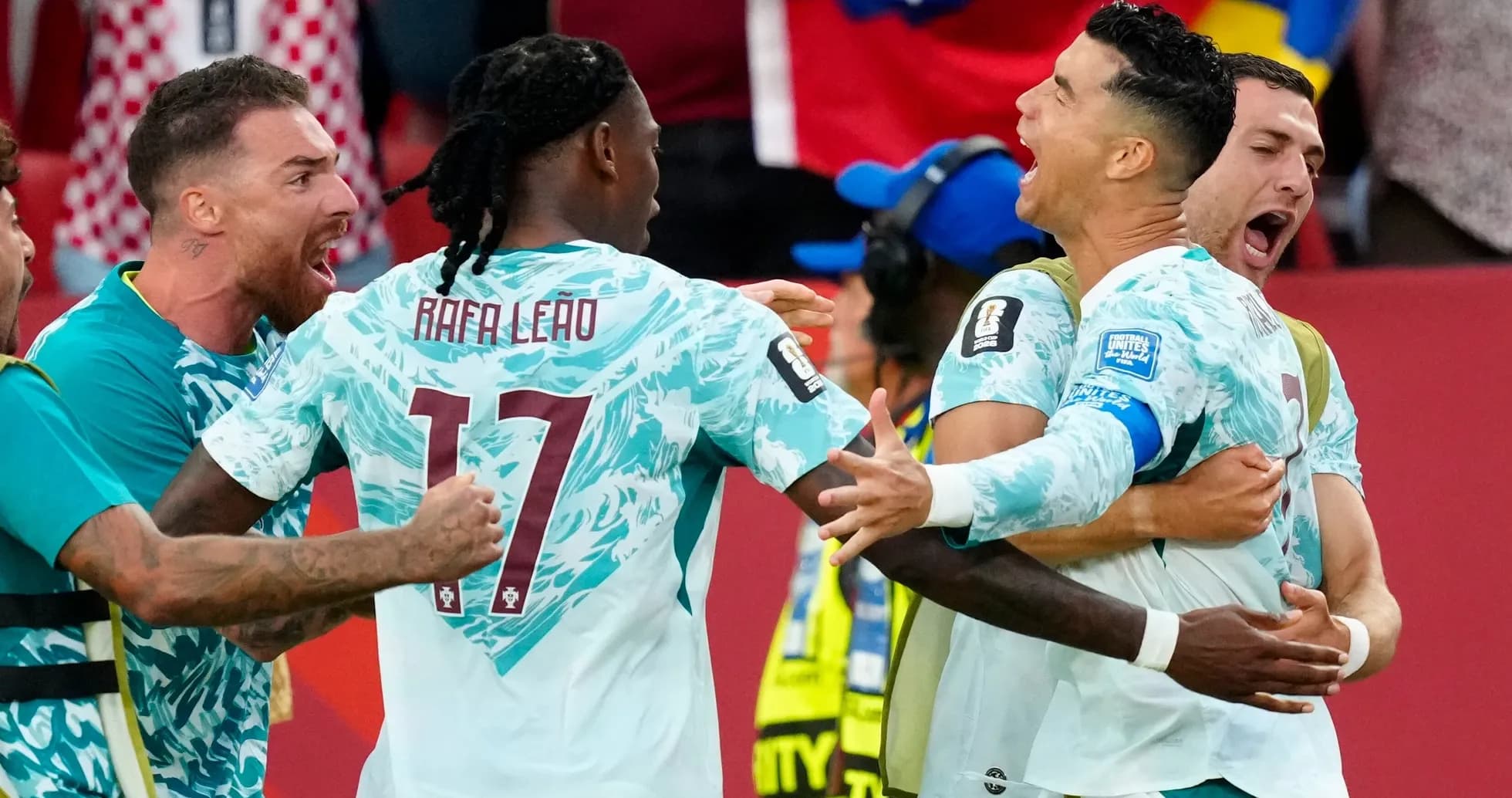
These changes effectively transformed Portugal’s 4-2-3-1 into a more aggressive, asymmetrical shape with two central reference points in the box and wide creators supplying them. The immediate tactical impact was visible in the penalty incident at 68', which Ronaldo converted to level the match. With more bodies occupying Croatia’s central defenders, Croatia’s back line was repeatedly forced into last-ditch interventions, and their foul count (12 to Portugal’s 6) reflected the strain.
Croatia tried to regain control by introducing Mario Pašalić (IN) for Martin Baturina (OUT) at 68', seeking more box-running and aerial presence from midfield. Later in stoppage time, Joško Gvardiol (IN) replaced Nikola Vlašić (OUT) at 90+2', and Andrej Kramarić (IN) came on for Mateo Kovačić (OUT) at 90+6', pushing Croatia into a late, direct assault phase with added physicality and crossing threat. However, these moves came after Portugal had already seized momentum.
The decisive tactical blow arrived at 81' when Rúben Neves (IN) replaced Cristiano Ronaldo (OUT). Far from a defensive retreat, this substitution rebalanced Portugal’s midfield, ensuring better control of second balls and allowing Portugal to manage transitions more effectively while still maintaining a central striker in Gonçalo Ramos. With Neves joining João Neves in deeper zones, Portugal could recycle possession and re-press immediately after losing the ball, limiting Croatia’s late transition opportunities.
The winning goal at 90+4', scored by Gonçalo Ramos and assisted by Rafael Leão, perfectly encapsulated Portugal’s structural dominance in the closing stages. Leão, still operating high and wide, drew defenders out and delivered into a penalty area now consistently occupied by a true centre-forward. Ramos’ presence as a fresh, central target was the direct product of Martinez’s mid-game reshaping of the attacking line.
Defensively, Portugal’s discipline in structure contrasted with Croatia’s increasing desperation. Rúben Dias’ yellow card at 17' for “Elbowing” was an isolated early incident rather than a pattern. Croatia, by contrast, collected two late cards as they chased the game: Luka Modrić at 59' for “Tripping” and Perišić at 90+8' for “Unsportsmanlike conduct”. These moments reflected a side stretched physically and mentally by long defensive phases.
From a statistical standpoint, the match’s numbers validate the tactical story. Portugal’s 61% possession and 584 passes at 91% accuracy (584 passes, 532 accurate, 91%) show a team comfortable dictating tempo and territory. Croatia’s 368 passes at 85% accuracy (368 passes, 311 accurate, 85%) underline their more direct, transition-oriented approach. Both sides generated most of their danger inside the box (10 shots inside for each), but Portugal’s superior xG (2.18 to 1.34) and higher shot volume tilted the balance.
In goal, Diogo Costa (Portugal) made 5 saves, a reflection of Croatia’s ability to produce six shots on target despite limited possession, while Dominik Livaković (Croatia) registered 2 saves against Portugal’s three shots on target. The identical negative goals prevented figure for both keepers (-0.45) indicates that each conceded slightly more than the quality of chances might have suggested, reinforcing the idea that the decisive edge came not from goalkeeping heroics but from structural control and smarter in-game adjustments.
Ultimately, Portugal’s win was built on a clear possession framework, bold mid-game reconfiguration of the front line, and a late shift back towards midfield control. Croatia’s compact block and transition threat kept them competitive, but their inability to sustain pressure without sacrificing defensive stability left them vulnerable to Portugal’s layered attacking structure in the decisive final minutes.