Iran and New Zealand's Tactical 2-2 Draw Analysis
Iran and New Zealand produced a tactically balanced 2-2 draw at SoFi Stadium, a match defined by contrasting structures and different routes to chance creation. Iran, in a 4-4-2 under Amir Ghalenoei, leaned on width and full-back aggression, while New Zealand’s 4-2-3-1 under D. Bazeley prioritised central control and vertical supply into Chris Wood. The statistical profile – 48% possession and 17 shots for Iran against 52% and 14 shots for New Zealand – underlines a game where Iran traded some control for volume of attempts, and New Zealand maximised efficiency and clarity in their attacking patterns.
Iran’s 4-4-2 was built on a relatively orthodox back four with Milad Mohammadi and Ramin Rezaeian as key outlets. The double pivot of Saeid Ezatolahi and Saman Ghoddos supported a narrow midfield line, asking the wide midfielders – Mohammad Mohebi and Aria Yousefi – to step inside selectively and free the full-backs to advance. This structure explains Iran’s edge in total shots (17) and blocked efforts (5): they consistently managed to work the ball into advanced crossing and half-space positions, especially down the right through Rezaeian, forcing New Zealand’s block to absorb repeated deliveries and second balls around the box. Ten shots inside the box show that Iran were able to penetrate, but the final execution was often rushed or crowded.
New Zealand’s 4-2-3-1, with Joe Bell and Marko Stamenic as the double pivot, offered a cleaner possession platform. Their 52% share of the ball, higher pass volume (446) and notably superior passing efficiency – 446 passes, 377 accurate (85%) versus Iran’s 405 passes, 312 accurate (77%) – point to a side more comfortable circulating under pressure and progressing methodically. Bell and Stamenic were central to this, recycling possession and connecting to the three behind Wood: Elijah Just, Sarpreet Singh and Callum McCowatt. The fact that New Zealand generated 8 shots on goal from only 14 total attempts, compared to Iran’s 4 from 17, reflects a more selective shot profile, with attacks often ending in clearer looks rather than speculative efforts.
Goals
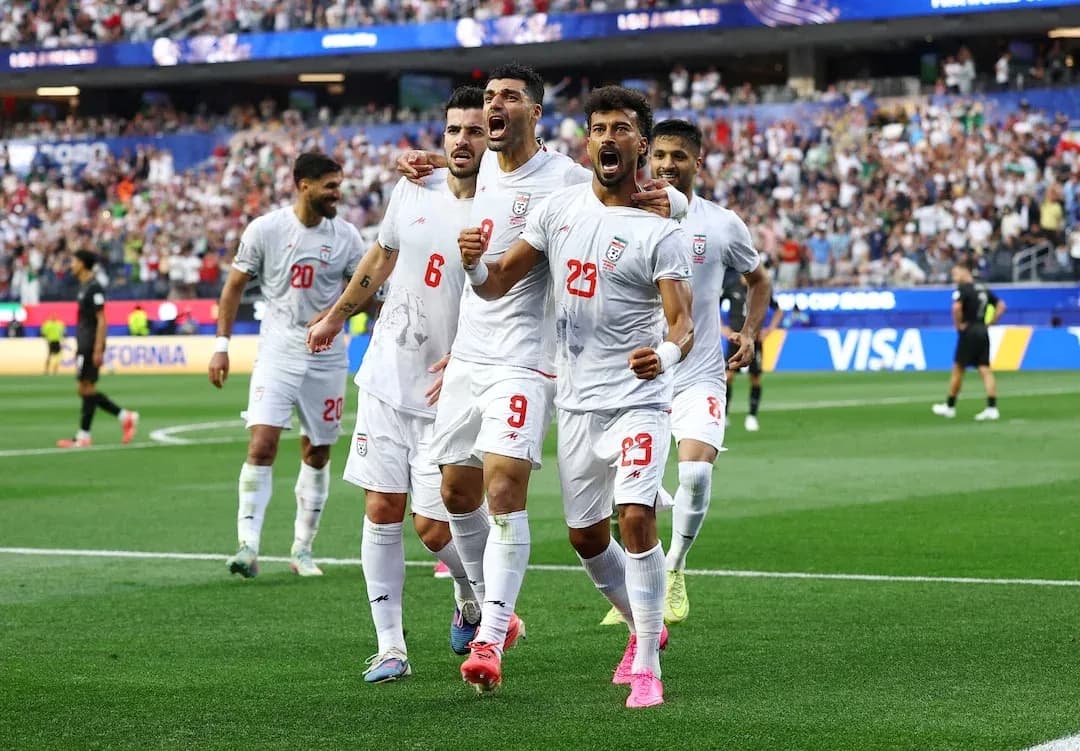
The early goal from New Zealand, finished by Just and assisted by Wood, stemmed directly from their structural idea: Wood occupying centre-backs, Just attacking the space created from the line of three. Iran’s equaliser, coming from Rezaeian, was much more emblematic of their approach – full-back involvement, second-phase presence and numbers committed into advanced zones. The second half continued that tactical duel. New Zealand’s second goal, again Just from a Wood assist, underlined the effectiveness of their vertical connections. Iran’s response through Mohebi, assisted by Rezaeian, highlighted how their right side became the primary creative lane as the match wore on.
Substitutions
Substitutions subtly shifted the tactical balance. At 46', Mahdi Ghayedi (IN) came on for Aria Yousefi (OUT), signalling Iran’s intent to inject more direct dribbling and attacking flair from wide areas, likely to destabilise New Zealand’s full-backs. At 53', Ali Alipour (IN) replaced Shahriar Moghanlou (OUT), refreshing the forward line and preserving the two-striker structure rather than altering shape. The 65' change – Ehsan Hajsafi (IN) for Saman Ghoddos (OUT) – brought extra defensive nous and left-sided balance, giving Iran more stability in transition while still allowing Mohebi to attack from midfield.
New Zealand’s substitutions were more about energy management than structural overhaul. At 68', Benjamin Old (IN) came on for Liberato Cacace (OUT) and Ryan Thomas (IN) for Callum McCowatt (OUT), moves that likely nudged the shape toward fresher legs in the wide and central lanes without abandoning the 4-2-3-1 principles. At 78', Callan Elliot (IN) for Tim Payne (OUT) maintained the full-back profile but with renewed intensity. Deep into added time, Jesse Randall (IN) for Sarpreet Singh (OUT) and Tyler Bindon (IN) for Marko Stamenic (OUT) at 90+2' suggested a final adjustment to protect the draw and secure defensive presence in the closing moments.
Defensive Analysis
Defensively, Iran’s 10 fouls and single yellow card – to Hajsafi for “Tripping” at 89' – indicate a side that generally maintained structure without resorting to persistent tactical fouling. Their back four, marshalled by Shoja Khalilzadeh and Ali Nemati, had to deal with Wood’s physical presence and the late runs of Just, but the shot profile (New Zealand with 10 shots inside the box but only 14 overall) shows that while they conceded territory in key moments, they limited volume and forced New Zealand to be extremely efficient with the chances they did create.
New Zealand, with only 8 fouls and no cards, defended more through positioning and compactness than through aggressive duels. The central defensive pairing of Finn Surman and Michael Boxall benefited from the protection of Bell and Stamenic in front, funnelling Iran wide and accepting crosses rather than allowing direct central combinations. Iran’s 4 corner kicks to New Zealand’s 1 further highlight how often Iran pushed the ball into the final third and forced last-ditch interventions, but New Zealand’s box defence was generally well-organised.
Goalkeeping Perspective
From a goalkeeper perspective, both sides’ statistical profiles point to challenges. Iran’s goalkeeper, Alireza Beiranvand (Iran), faced 8 shots on goal and, with 6 saves, conceded twice. New Zealand’s goalkeeper, Max Crocombe (New Zealand), registered 2 saves against 4 shots on goal. The goals prevented metric at -0.2 for both teams suggests that each goalkeeper underperformed slightly relative to the quality of shots faced; neither was decisively outplaying the underlying xG.
The xG numbers frame the draw as broadly fair: Iran at 1.5 xG versus New Zealand’s 1.24. Iran’s higher shot volume and blocked attempts reflect their territorial pressure and crossing-heavy approach, while New Zealand’s marginally lower xG but superior shot-on-target count underscores their efficiency and clarity in exploiting key moments through the Wood–Just axis. Iran’s slightly inferior passing accuracy (77%) compared to New Zealand’s 85% captures the trade-off in their game model: more direct, more vertical, and more reliant on chaos in the final third.
In the context of a World Cup group opener, this 2-2 result and its underlying metrics suggest two teams with distinct, coherent identities. Iran showed they can generate sustained pressure and volume, especially via full-back involvement and dual strikers, but must refine shot selection and box occupation to convert possession into higher-quality chances. New Zealand demonstrated a disciplined, possession-based 4-2-3-1 with a clear attacking spine, but their reliance on a few key combinations leaves them vulnerable if those links are disrupted. Tactically, the draw was an accurate reflection of a match where structure met improvisation and neither side quite found the extra layer of control needed to tilt the balance.